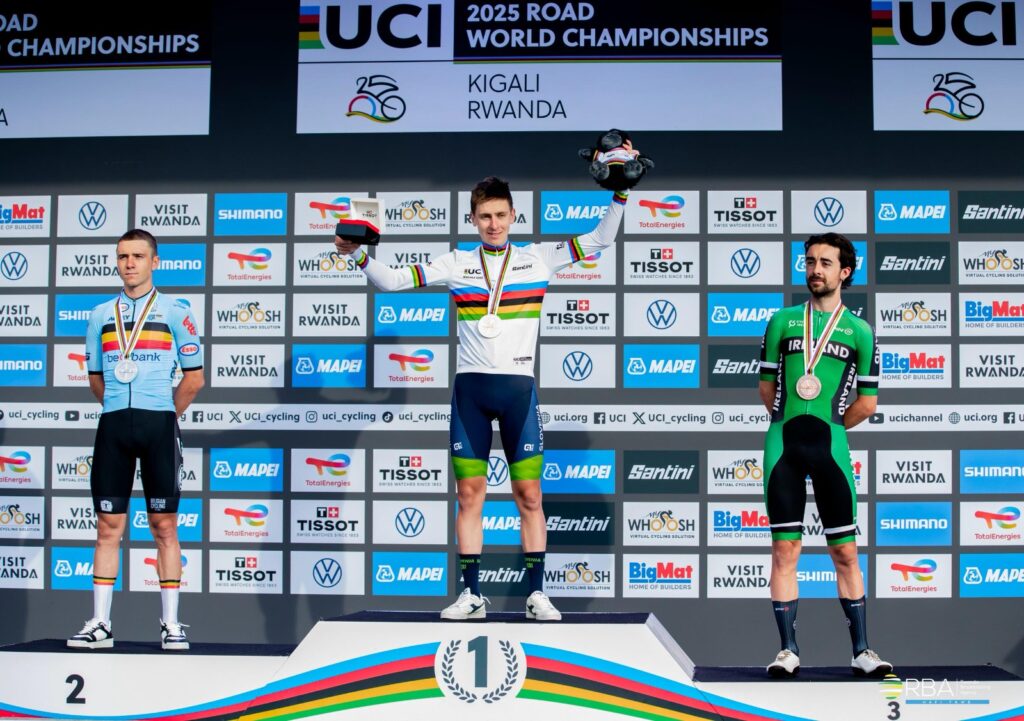
‘The cycling world governing body, UCI (Union Cycliste Internationale), is being accused by, among others, human rights groups, Belgian parliamentarians and self-exiled Rwandan journalists of falling prey to the Rwandan government’s ploy of hoodwinking the entire world through sports.
These critics, loud in nature but few in number, accuse the Rwandan government of using the UCI world championships in Kigali, to hide its external actions and internal ‘warts’ from the eyes of the world.
Rwanda Isn’t on the World’s Radar
Before I proceed, I’d like to ask a simple question. Even before there was a UCI championship, did the world really, really care about the Eastern DRC crisis? Did it care about Victoire Ingabire’s imprisonment? Did it care about Rwanda at all? The answer, my friends, is “no”.
The world (and in world I mean the states and blocs that run the globe) are currently dealing with existential crisis’s- migration, antisemitism, declining birth rates, the waning of traditional values and while there is an emergence of new global powers and the slow, relative decline of the western victors of the Second World War- France, UK and the US. They don’t have time, the military might or the interest to deal with issues emanating from African states that, though we hate to admit it, are fundamentally useless to them.
Anyway, enough of that…lets go back to the critic’s accusations of using the UCI World Championships to sports wash Rwanda’s image. This accusation holds very little water when you take a step back and examine in detail what Rwanda needed to do to pull off these championships
Sportswashing or Sports as a Development Strategy?
The roads that even the elite European cyclists have called ‘immaculate” weren’t built after winning the UCI World Championships bid in 2021. The famous cobbles of Cote de Kimihurura and Mur de Kigali were built over a decade ago. The visa-on-arrival regime that allowed this UCI Championship to have the most teams ever isn’t four years old. Neither is the capacity of Rwanda’s private and public sector to handle the intricacies of such an event a simple ‘by the way’.
All of this was built brick by brick. And anyone who truly understands Rwanda knows that the ‘building’ that we see today was founded, in my opinion, in 1997, when the architects and dreamers of today’s Rwanda met in Urugwiro Village to articulate the vision of Rwanda they intended.
In my view, without Vision2020, which was one of the most major outcomes of the Village Urugwiro dialogues, they’d be no UCI Championship in Kigali. So, to act like bidding for, and winning, the 2025 UCI World Cycling Championship was a nefarious ploy to take global eyes off eastern Congo and the imprisonment of Victoire Ingabire simply doesn’t make sense.’
Rwanda didn’t wake up one morning and decide to “polish” its image with cycling. It has been methodically building institutions, infrastructure, and global partnerships brick by brick.
Tangible Benefits Beyond Optics
The UCI World Championships were not just a showpiece. They delivered real gains:
- Tourism and economy: Thousands of visitors boosted hotels, airlines, and local businesses — from boda riders to SMEs supplying logistics.
- Sporting legacy: Rwanda now has world-class cycling infrastructure, training facilities, and most importantly, a generation of inspired young riders.
- Global profile: The event put Rwanda firmly on the sporting map, expanding its appeal into active, aspirational branding.
These are measurable dividends, not symbolic gestures.
A Question of Double Standards
Then there is the matter of fairness. Why is it “sportswashing” when Rwanda hosts, but “soft power” when others do the same? The United States going to host the FIFA World Cup next year, even while people are getting shot and killed live on our mobile phone screens and its president is dismantling the international system as we speak.
The US isn’t getting stripped of the right to leverage sport for visibility. So why should Rwanda?
More Than Optics: A Vision of Nation-Building
The truth is simple: the UCI World Championships in Kigali were not a fluke. They were a culmination of decades of policy, planning, and perseverance. Hosting the world’s biggest cycling event was not about erasing flaws. It was about showcasing progress and projecting confidence.
That doesn’t mean Rwanda is beyond criticism. But to dismiss such an achievement as mere “sportswashing” is lazy analysis. It denies the agency of Rwandans who have worked for decades to rebuild their country. And it overlooks the power of sport to do more than entertain — to inspire, to connect, and to build nations.
Rwanda’s UCI World Championships were not about hiding. They were about arriving.